About SPAR
Sustainable Performance Assessment for Residential Buildings
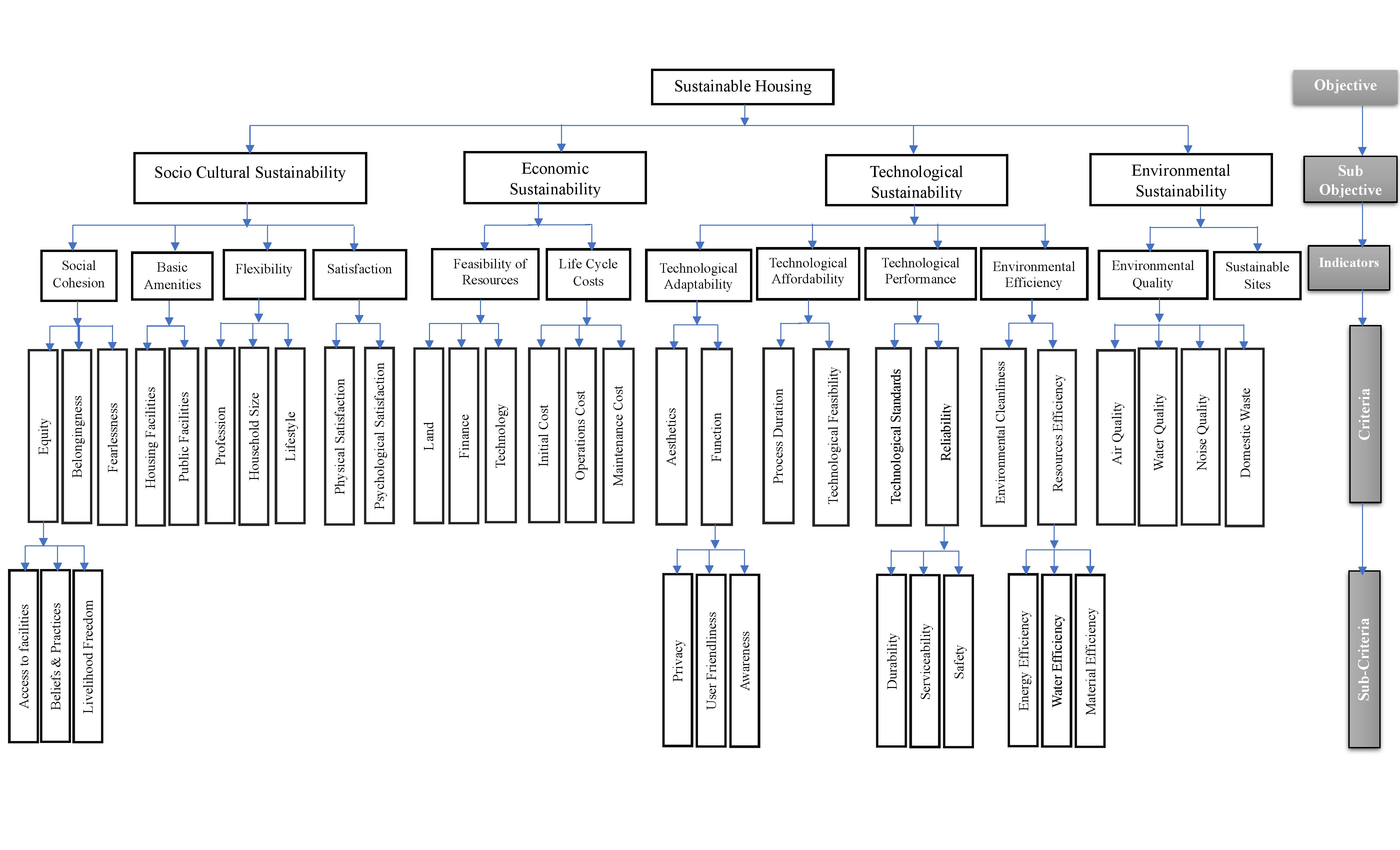
Welcome to SPAR, a pioneering tool designed to assess and enhance the sustainability performance of residential buildings, particularly in developing countries. In a world where environmental challenges are increasingly pressing, SPAR provides an effective framework for evaluating and improving the sustainability of housing solutions by considering social and economic factors. The tool provides a Sustainable housing index based on building design parameters assessed under four key sustainability dimensions: Socio-Cultural Sustainability, Economic Sustainability, Technological Sustainability, and Environmental Sustainability. Each of these objectives encompasses a range of indicators, criteria, and sub-criteria, ensuring a thorough evaluation of residential buildings. This comprehensive approach allows users to easily identify weak points in a building's design and offers actionable insights to rectify these issues, ultimately improving overall building sustainability.
By focusing on vital sustainability indicators — including social aspects, economic and technological feasibility, and environmental impact, SPAR empowers stakeholders such as architects, builders, policymakers, and homeowners to make informed decisions that contribute to sustainable living. By providing clear guidance to building designers on multiple aspects of sustainability, SPAR helps create homes that not only fulfill the needs of today but also preserve the environment for future generations.
Objectives
Socio-Cultural Sustainability
Socio-cultural sustainability in housing can be defined as one which adapts to the varying needs of the users thereby enhancing their overall well-being.
Economic sustainability
Economic sustainability in housing refers to the affordability of those housing options which are socially amicable, environmentally responsible, and technologically sustainable.
Technological sustainability
Technological sustainability in housing refers to the use of adaptable, affordable and sustainable technological options, including construction and the installation of services (plumbing, drainage, and electrification) that meet the needs of users.
Environmental sustainability
Environmental sustainability in housing can be achieved by adopting environmentally friendly housing options which have minimal impact on the natural environment through conserving resources, and optimizing pollution.

SPAR Certification – Mandatory Conditions
Under the SPAR assessment framework, each of the four sustainability objectives—Socio-cultural, Economic, Technological and Environmental—carries a maximum of 25 points, giving a total weighted score of 100 points.
Residential buildings are classified into four certification categories based on their final SPAR certification score:
To uphold the underlying principle of equal significance of the four sustainability objectives , the following conditions shall apply:
- Minimum Objective Requirement: A minimum score of 50% (12.5 out of 25 points) in each of the four sustainability objectives is mandatory for SPAR certification.
- Final Certification Score: The final SPAR certification score shall be calculated by multiplying the lowest score obtained among the four sustainability objectives by four.
Final SPAR Certification Score = 4 × Lowest Objective Score
The certification category shall be determined using this final certification score
Score Range |
Certification Category |
Sustainability Level |
|---|---|---|
80 to 100 |
Platinum SPAR |
Exceptional sustainability |
70 to <80 |
Gold SPAR |
Strong sustainability performance |
60 to <70 |
Silver SPAR |
Good sustainability, fulfilling most key criteria. |
50 to <60 |
Basic SPAR |
Meets basic sustainability requirements but needs improvement |
<50 |
Not Certified |
Below sustainability standards; significant upgrades required. |
SPAR CHART